Integration with LLM Engine
This tutorial covers the key information for integrating XGrammar into an LLM serving engine: the lifecycle of XGrammar objects, the integration points in the engine’s decoding step, batched inference, and speculative decoding. Read Workflow of XGrammar first for the basic usage of each component.
Object Lifecycle in an Engine
XGrammar objects fall into two lifecycle categories in a serving engine.
Per-model objects are constructed once and reused for all requests:
xgr.TokenizerInfoencapsulates the vocabulary information of the model.xgr.GrammarCompilercompiles grammars for this model. Keep one persistent compiler per model, so that its compilation cache is shared across requests.xgr.CompiledGrammaris the compilation result. Requests using the same grammar can share one compiled grammar.
Per-request objects:
xgr.GrammarMatchermaintains the matching state of one request, so each request needs its own matcher. When the request finishes, discard the matcher orreset()it for reuse.
Compiling a complex grammar can take non-negligible time, so it should not block the engine’s main loop. Compile the grammar asynchronously when the request arrives, so that compilation overlaps with the prefill phase of the request, as shown in the figure in the next section. See Multi-threaded Compilation for the asynchronous compilation API.
Integrating into the Engine Step
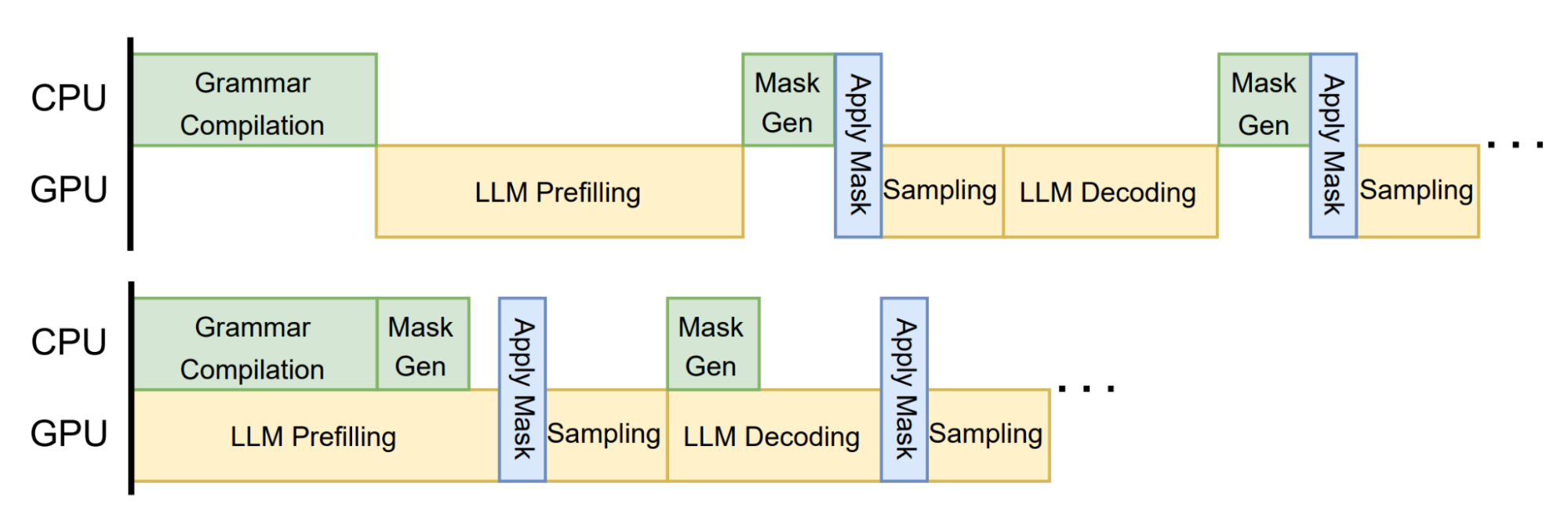
The figure shows how grammar processing fits into the engine’s timeline. In the top pipeline, grammar processing runs serially with LLM inference. In the bottom pipeline, grammar compilation overlaps with prefilling, and mask generation overlaps with the GPU forward pass. XGrammar’s mask generation runs on the CPU, so a serving engine can hide almost all of its latency behind GPU computation.
There are three integration points in each decoding step:
Fill the token bitmask.
xgr.GrammarMatcher.fill_next_token_bitmaskcomputes the mask for the next token on the CPU. It only depends on the matcher state, so it can start as soon as the last token is accepted, running in parallel with the GPU forward pass of the current step. It returns a booleanneed_apply; ifFalse, the mask allows all tokens and the applying step below can be skipped.Apply the bitmask to the logits.
xgr.apply_token_bitmask_inplacesets the logits of invalid tokens to-infbefore sampling. Copy the bitmask to the logits’ device first; on CUDA devices it launches an optimized kernel. If structured and unstructured requests are mixed in one batch, pass theindicesparameter to mask only the rows of the structured requests.Accept the sampled token.
xgr.GrammarMatcher.accept_tokenadvances the matcher state after sampling. It returnsFalseif the token does not conform to the grammar, which can only happen when the mask was not applied to the logits.
To decide when the structured generation ends, check
xgr.GrammarMatcher.is_terminated in the engine’s
stopping condition.
Batched Inference
In a batch, each request has its own matcher, and all requests share one bitmask tensor:
request i fills row i of the bitmask, and a single
xgr.apply_token_bitmask_inplace call masks the whole
logits batch.
xgr.BatchGrammarMatcher performs the per-request operations
in one pass on the C++ side with multiple threads, avoiding Python-side loops:
matchers = [xgr.GrammarMatcher(compiled_grammar) for _ in range(batch_size)]
token_bitmask = xgr.allocate_token_bitmask(batch_size, tokenizer_info.vocab_size)
batch_matcher = xgr.BatchGrammarMatcher(max_threads=8)

# In each decoding step:
batch_matcher.batch_fill_next_token_bitmask(matchers, token_bitmask)
xgr.apply_token_bitmask_inplace(logits, token_bitmask.to(logits.device))
next_token_ids = sample(logits)  # engine-specific sampling
xgr.BatchGrammarMatcher.batch_accept_token(matchers, next_token_ids)
batch_fill_next_token_bitmask
also accepts an indices parameter to fill only a subset of the bitmask rows, matching the
indices parameter of apply_token_bitmask_inplace.
batch_accept_string and
batch_rollback are the batch versions of the
corresponding xgr.GrammarMatcher methods.
batch_fill_temperature fills a
float32 CPU tensor with the effective sampling temperature of each matcher in one pass
(-1 for matchers without a configured temperature), for grammars that use the
temperature rule attribute.
Speculative Decoding
In speculative decoding, a draft model proposes several draft tokens organized as a chain or a tree, and the target model verifies them in one forward pass. For structured generation, the engine also needs a token bitmask at every draft position to verify that the draft tokens conform to the grammar.
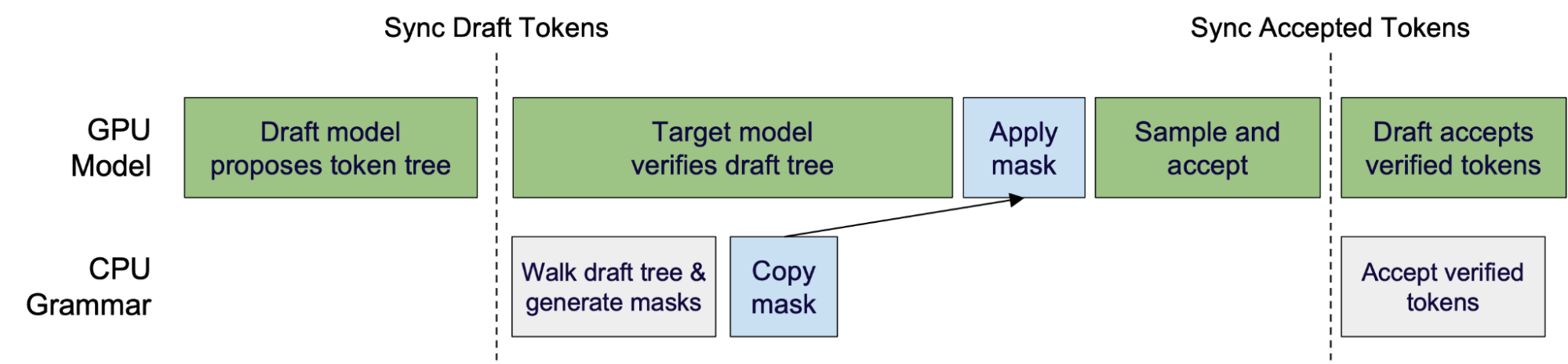
Draft tree traversal.
xgr.GrammarMatcher.traverse_draft_tree
traverses a draft token tree once and fills the bitmask for every node. The tree is encoded
with three int64 tensors: draft_tokens[i] is the token id of node i,
retrieve_next_token[i] is the first child of node i, and retrieve_next_sibling[i] is the
next sibling of node i (-1 means none). The time_threshold parameter bounds the traversal
time: if exceeded, the method stops and returns False.
As the figure shows, the traversal runs on the CPU while the target model verifies the same tree on the GPU, so mask generation overlaps with the verification. This draft tree traversal API was first proposed by the SGLang team.
Manual state control. For chain-shaped drafts, or for finer-grained control over the tree,
the engine can walk the draft manually: fill the bitmask and accept each draft token in turn,
then roll back the rejected suffix with
xgr.GrammarMatcher.rollback after the verification
(batched version:
batch_rollback). To explore multiple branches
with independent states, duplicate the matcher with
xgr.GrammarMatcher.fork.
Jump-forward decoding.
xgr.GrammarMatcher.find_jump_forward_string
returns the longest string that certainly follows the current state under the grammar. The
engine can append this string to the output directly without LLM decoding, saving decoding
steps.
Real-World Integrations
XGrammar has been integrated into mainstream LLM serving engines. Their integration code can serve as a reference: SGLang, vLLM, TensorRT-LLM, and MLC-LLM.